Elevated Platform: The Patented System Bringing Padel to Any Terrain
Padel’s global growth is running into a physical limit. Not every site can take a conventional court. Rooftops, sloping plots, existing hard surfaces or venues with restrictive permitting have traditionally been ruled out for padel development, because standard installation depends on reinforced concrete foundations and significant civil works. An approach that works well on paper but often stalls real projects once the site doesn’t cooperate.
Portico Sport developed the Elevated Platform to remove that limit. It is a patented structural system, engineered in-house, that supports a full padel court without a traditional foundation. It opens to new locations that were previously not viable for the sport, without asking clubs, developers or investors to compromise on playing quality to get there.
What Is an Elevated Platform for a Padel Court?
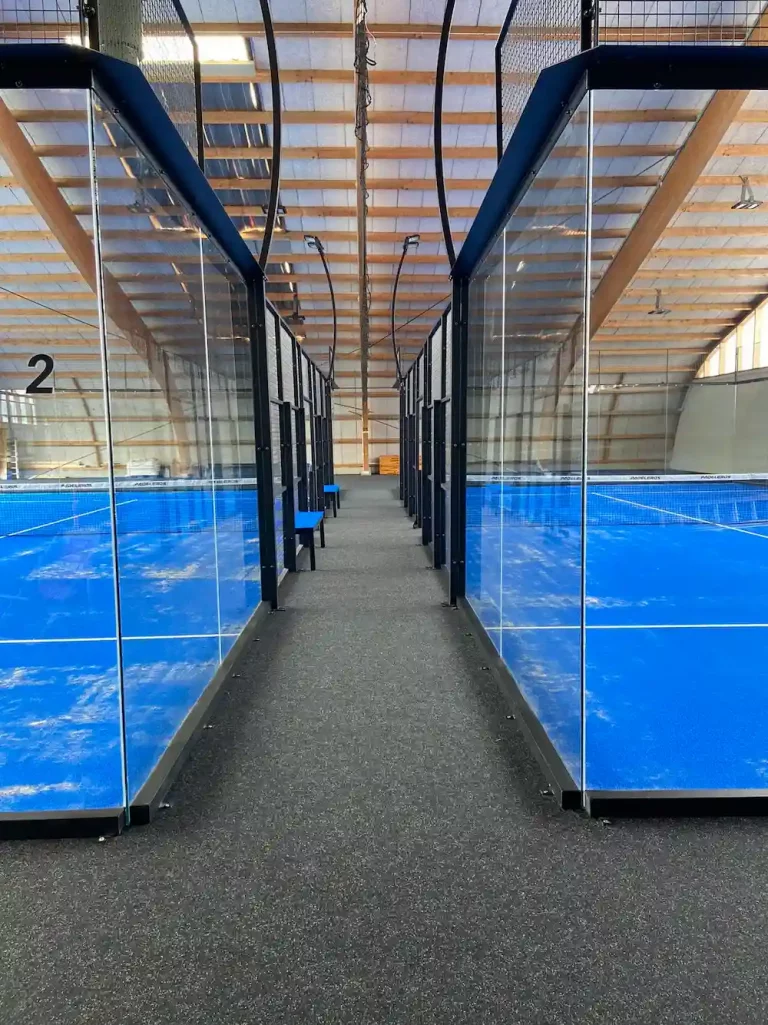
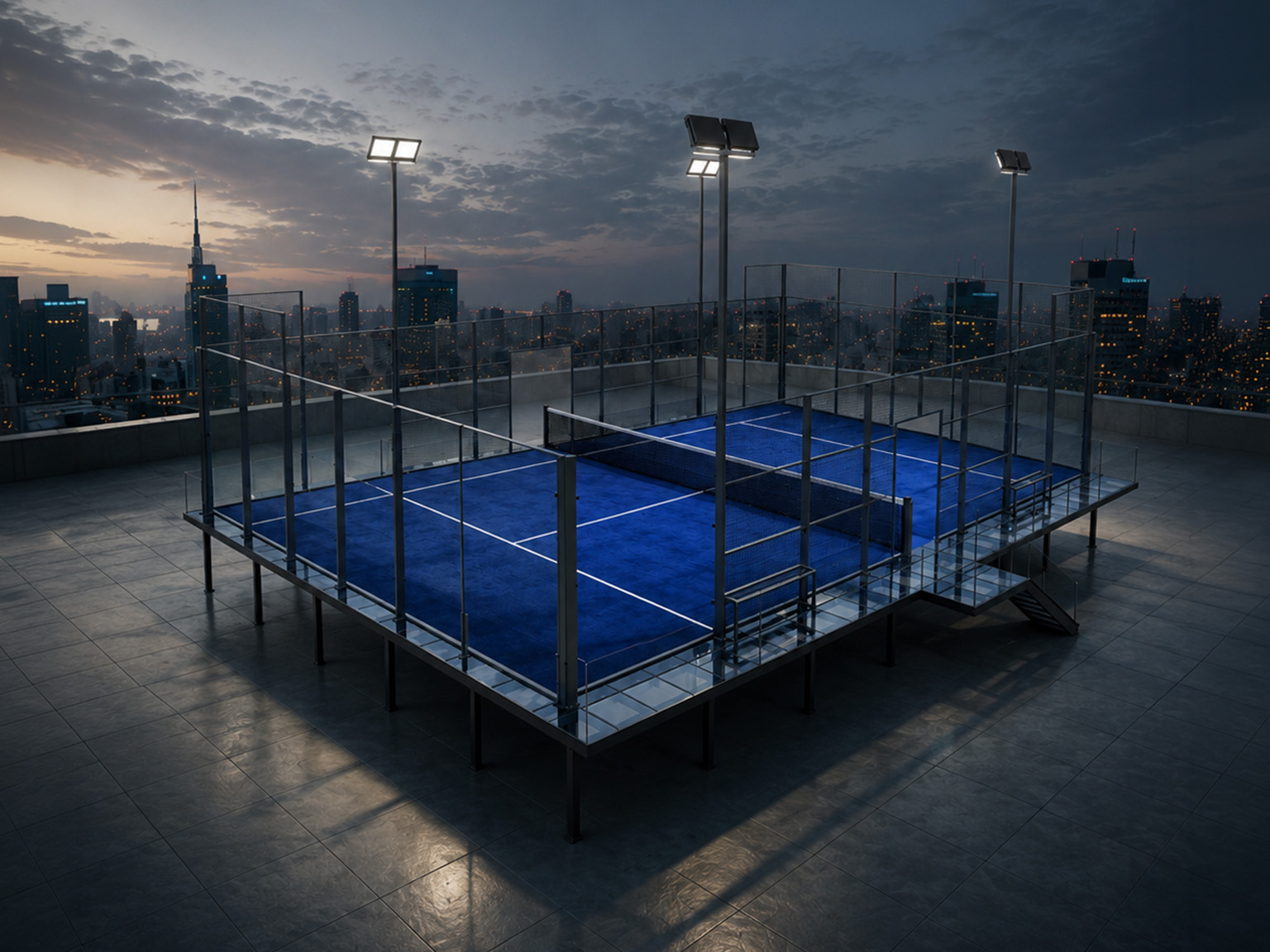
An Elevated Platform is a modular, structural base engineered to support a padel court above ground level, replacing the reinforced concrete slab required by conventional installation. Instead of extensive groundwork, the system rests on an adjustable pillar structure that adapts to the terrain itself.
This is Portico Sport’s patented model, and it is compatible with the brand’s full range of court types – from the Ace and Club to Panoramic and Tournament models – so clubs, hotels and developers are not limited in design once they choose the platform.
Where Conventional Foundations Fall Short
Reinforced concrete remains the right solution for the majority of projects. But it assumes flat, accessible, buildable ground. And that assumption breaks down more often than developers expect: uneven terrain requires costly leveling, rooftops cannot take traditional groundwork, existing hard surfaces mean demolition before excavation, and temporary venues make a permanent slab impractical in the first place.
The Elevated Platform is built precisely for these scenarios. Its adjustable pillar system absorbs terrain variation without extensive leveling, and because installation doesn’t require reinforced foundations, the permitting process is also simplified. In most cases, only a soil report is needed before installation. For developers working against tight timelines or restrictive planning environments, that difference alone can decide whether a project moves forward at all.
Engineered to Match a Traditional Court, Not Just Support One
The technical challenge of an elevated system is not holding the court up – it’s making it play identically to one installed on solid ground. Elevated structures have a reputation for introducing vibration, instability or inconsistent ball bounce, and that reputation is deserved when the engineering behind them is generic.
Portico Sport’s platform was developed specifically to avoid that outcome. Each unit is engineered and validated to the same structural resistance as the brand’s Club court model, capable of withstanding equivalent wind loads.
The result carries the same 10-year warranty as every Portico Sport court, and manufacturing follows the same in-house process across the range. Structural steel, robotic welding and precision laser cutting are all produced under the company’s own quality control rather than outsourced.
Developed With Queens Club London – and Tested at Elite Level
The Elevated Platform was developed over more than a year in collaboration with Queens Club London, one of the world’s most prestigious racket clubs. Prototypes were installed and refined through direct feedback from club management and players until the system reached the consistency required for competitive play.
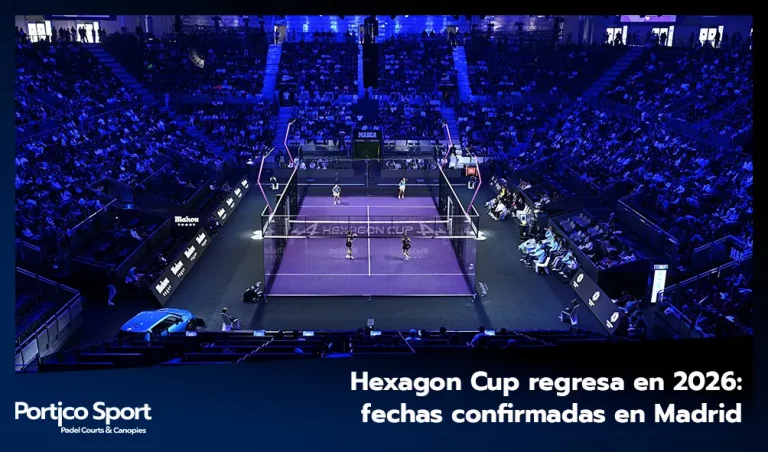
That validation has continued at professional level. Jose Calvo-Sotelo — co-founder of Hexagon Cup and Teams & Players Director, and owner of Mad4Padel, one of Madrid’s leading clubs — tested the platform ahead of using it for the tournament:
“At Hexagon Cup, the playing experience for the world’s best athletes is non-negotiable. After testing it, the Elevated Platform developed by Portico Sport has demonstrated the level of stability and performance required for competition. It’s an important innovation for the future and it opens a window of possibilities for clubs and tournament organisers to bring padel to virtually any location.”
For tournament organisers and elite clubs, that combination of engineering data and on-court validation is what separates a viable elevated system from a compromise.
Where the Elevated Platform Makes the Difference
The system was designed around real project constraints, and it shows in the range of installations it enables.
- Rooftops. Converting unused space into a court without major structural intervention on the building below, a route that’s increasingly relevant for urban clubs and commercial developments with no ground-level space left to build on.
- Hotels and resorts. Adding a premium amenity on sites where ground conditions, terrain or available space would otherwise rule out a padel court entirely.
- Sloping or uneven terrain. Avoiding the earthworks a conventional slab would require, which often represent one of the largest hidden costs in a padel project.
- Existing hard surfaces. Installing directly over concrete or paved areas without demolition, cutting both cost and installation time.
- Temporary and event installations. Tournaments or exhibitions needing fast setup, relocation or future expansion without the constraints of a permanent structure.
- Club expansions. Adding courts to existing facilities with minimal disruption to ongoing operations, member access or existing infrastructure.
Full technical specifications and compatible court models are detailed on the Elevated Platform page.
Why It Matters for Clubs, Developers and Investors
For most padel projects, a traditional foundation is still the simplest, most cost-effective route. But when the site itself is the obstacle, whether because of terrain, structure, permitting or timeline, the choice has typically been to either compromise on location or abandon the project. The Elevated Platform changes that calculation. It extends where a professional-grade padel court can realistically be built, without extending the compromises usually attached to elevated systems.
That combination of engineering rigor and site flexibility is why Portico Sport positions the Elevated Platform not as an alternative product, but as an expansion of what’s possible for the next generation of padel developments.
About Portico Sport
Portico Sport is an international engineering and manufacturing company specializing in premium padel courts, steel canopies and innovative structural solutions for the global padel industry.
If your project involves a rooftop, an existing surface, a complex site or a professional event, our engineering team can assess whether the Elevated Platform is the right fit. Get in touch with Portico Sport.