How to Choose a Professional Padel Court: Technical Guide for Clubs and Investors
Choosing a professional padel court is not an aesthetic decision nor one based solely on initial cost. It is a structural decision that directly impacts profitability, maintenance, and long-term project durability.
In this article, we analyze the key factors that influence the choice of a professional court: structure, materials, maintenance costs, and the real criteria that determine the final installation price.
1. Define your actual usage level (the most common mistake)
Before comparing suppliers: What actual usage level will the court have?
In professional environments, courts are subjected to scenarios very different from those in a recreational club:
- Daily intensive use
- High player turnover at diverse skill levels
- A combination of classes, matches, and events
- Continuous climate exposure in outdoor installations
Applying recreational court specifications to professional installations is the biggest mistake. A court designed for two hours daily will degrade rapidly under intensive use.
Structural design must be based on actual usage. Underestimating this variable generates serious consequences: premature deformations, performance loss, operational downtime, and maintenance cost overruns that undermine project profitability.
2. Structure: the factor that really matters
Structure is the most critical element of a professional padel court. This is where manufacturers who perform real engineering stand out from mere assemblers.
An adequate structure directly defines:
- Safety: Capacity to withstand dynamic loads without risk
- Stability: Predictable performance under intensive use
- Lifespan: Resistance over time and degradation
- Maintenance cost: Fewer incidents = fewer operational downtime
A professional court necessarily requires:
- Specific structural calculation adapted to the real environment, not generic standard solutions
- Proven resistance to wind loads, intensive use, and thermal variations
- Sufficient rigidity to prevent vibrations that affect playing experience
- Validated materials and manufacturing processes for sustained intensive use
The difference between a manufacturer with engineering capacity and one that only assembles components lies in calculation rigor, validation of each component, and the ability to respond technically to deviations or project changes.
3. Materials and suppliers: where real maintenance is determined
Materials not only define initial performance but also long-term behavior and actual operational cost. In wear elements such as turf, the impact is immediate and recurring:
- Daily intensive use causes constant friction
- Continuous environmental exposure (UV rays, humidity, temperature)
- Demand for consistency in ball bounce and performance
- Need for replacement every X years (varies by quality)
What is the best padel court turf for professional use? The answer depends not only on fiber type but on the manufacturer and its ability to guarantee consistency.
Working with top-tier suppliers guarantees:
- Consistent bounce match after match
- Greater durability under intensive use
- Less frequent replacement (direct economic impact)
- Better playing experience and safety
In contrast, low-quality materials or suppliers lacking industrial capacity generate:
- Premature and visible wear
- Progressive performance loss
- Recurring costs from unplanned replacement
Choosing the right materials is an economic decision, not an aesthetic one. A higher initial investment pays for itself in 3-5 years through reduced maintenance and guaranteed operational stability.
4. Indoor, outdoor, and canopies: choosing by environment
Outdoor courts
Outdoor facilities require more demanding structural specifications due to continuous exposure:
- High structural resistance to withstand wind loads
- Corrosion protection on all metal components
- Capacity to withstand rain, snow, and thermal variations without degradation
- Adequate drainage to prevent water accumulation
The design of an outdoor court must anticipate how the material will behave under expansion-contraction cycles, oxidation, and accelerated wear from direct exposure.
Canopies
Canopies are not decorative extras. They are operational optimization tools:
- Allow greater control of play and more consistent competition conditions
- Facilitate intensive use without weather-related interruptions
- Enhance the player’s experience
- Protect court investment, extending its useful life
A well-designed cover also impacts club profitability: it allows extended operating hours, improves value proposition for members, and generates greater occupancy without degrading infrastructure.
5. Regulations: minimum requirement, not competitive advantage
Every professional padel court must comply with:
- International Padel Federation (FIP) technical standards
- Applicable structural regulations by jurisdiction
- User safety requirements
Meeting regulations is a baseline requirement that any supplier must guarantee. What differentiates is not compliance itself, but how it is integrated from the design phase.
At Pórtico Sport, regulations are considered from the very beginning of the structural calculation, not as final validation. This approach ensures that courts not only meet legal minimums but are designed with safety and performance margins that guarantee stability and consistent performance over the long term.
6. Panoramic courts and design: aesthetics without compromising performance
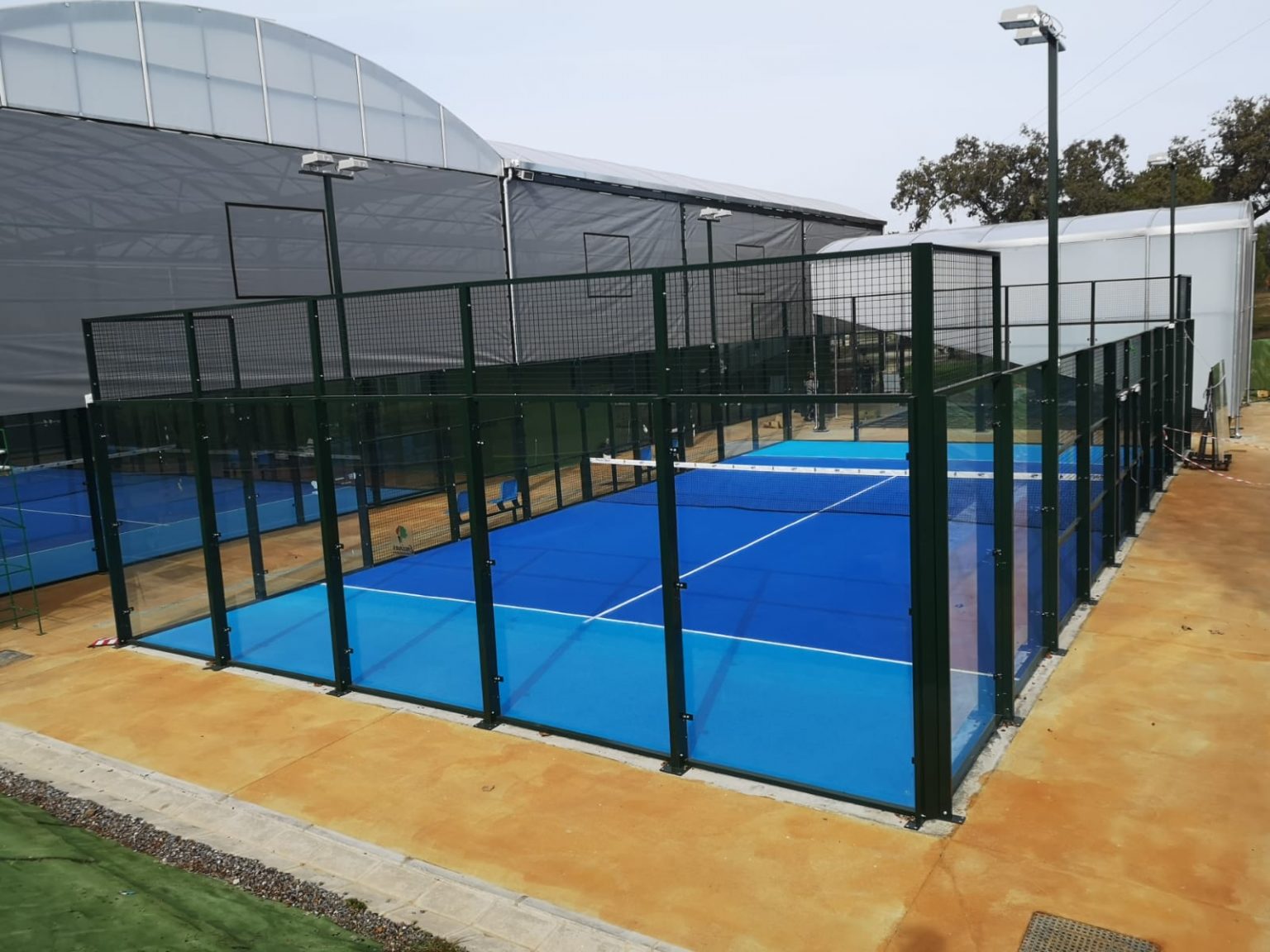
Panoramic courts offer an important differential in premium projects: greater spectator visibility, superior architectural integration, and added value in clubs, resorts, and high-end projects.
However, aesthetics without solid technical foundation creates mid-term problems. A panoramic court is only viable if it maintains:
- Structural rigidity equivalent to a conventional court
- Proven stability under intensive use
- Absence of vibrations or movements affecting play
This requires sophisticated structural design that compensates for the reduction in containment elements. Here, the manufacturer’s engineering capacity is decisive.
7. Real cost: maintenance and lifespan
One of the most overlooked analyses—and most costly in the long term—is calculating the total cost of ownership of a padel court.
Beyond the initial purchase price, actual operational cost depends on:
- Structural quality: A well-designed structure generates fewer incidents
- Materials: Determine replacement frequency and maintenance needs
- Usage level: Degradation intensity and repair requirements
- Supplier capacity: Availability of spare parts, technical service and problem response
A poorly designed court necessarily leads to: more operational incidents, unplanned downtime affecting revenues, recurring maintenance or replacement costs.
A court that costs 15–20% more initially but requires half the maintenance generates greater profitability and lower operational risk.
8. Beyond the product: service defines the final result
A padel court is not just a physical product. It is a complete technical project whose final result depends on multiple factors.
One common mistake is analyzing only installation price without considering the full project scope. The result depends on:
- Initial consulting: Accurate assessment of needs and specifications
- Engineering and design: Structural calculation tailored to the project
- Transport and logistics: Proper management of components to the job site
- Specialized installation: Assembly with technical criteria and functional validation
- After-sales service: Availability of technical support and spare parts
- Technical warranty: Economic and technical backing for defects
Many problems don’t come from the product itself but from poor execution at some stage of the project. Poor installation can compromise quality product. An incorrect design generates problems from day one. Poor logistics cause damage not visible until the court is in use.
A supplier that covers the entire process reduces these risks significantly, prevents delays, guarantees technical consistency, and allows real quality monitoring in each phase.
9. Mistakes to avoid
When selecting a professional padel court, there are decisions that, if made poorly, are difficult to correct:
- Underestimate the actual usage level of the installation and prioritize aesthetics over technical structure
- Failing to require a specific structural analysis tailored to your particular project
- Choose suppliers without industrial capacity (assemblers vs. real manufacturers) nor validate key materials
- Ignore comprehensive service: installation, logistics, follow-up, and after-sales are as important as the product
- Compare only initial price without analyzing total cost of ownership over 5-10 years
Conclusion: A strategic decision
A professional padel court is not defined on installation day. It is defined after years of intensive use, when the infrastructure demonstrates its capacity to maintain performance, safety, and consistency.
When structural design, materials, manufacturing processes, and execution are well defined from the start: operational incidents decrease, maintenance is optimized, and investment is protected.
Making the right choice not only reduces final or hidden costs. It prevents unforeseen problems and ensures that your padel court is a solid investment for years to come.
Do you need help evaluating a specific padel court or have questions about technical specifications? At Portico Sport, we offer comprehensive consulting for professional projects.